Ramón Unzueta (1962-2012) painted women who smoked, laid around, and were brokenhearted, seductive, happy or sad. But no matter how he portrayed his bohemian women, they all had their big, watery eyes in common, just like his favorite actress Bette Davis. Unzueta’s women never look defeated, they stare into your face ready to fight for a better life.
Ramón Unzueta was born in Havana, Cuba and attended the National School of Applied Arts. In 1992 he became a resident of Spain. Besides his portraits of women he is mainly known as an illustrator of children’s books and for his illustrations and cartoons in several magazines.
Bookcover ‘Caballo del Desierto’ by Olga Marta Pérez. Illustrated by Ramón Valdez
Bookcover ‘Los Aretes de la Luna’ by Zoé Valdés. Illustrated by Ramón Unzueta
Bookcover ‘Los Conejos son Azules’ by Isabel Pijeira. Illustrated by Ramón Unzueta
His style can best be described as surrealistic and magical. His works have been exhibited in galleries and museums in Europe and the United States, including the Flores Carbonell Collection.
‘Ms. Hanna’ by Sheldon Saint. Watercolor on paper.
‘Chile, I from Long Island’ by Sheldon Saint. Watercolor on paper.
‘Straw Bag’ by Sheldon Saint. Watercolor on paper.
Sheldon Saint is a master in depicting every-day Bahamian life. His quiet, intimate settings are recognizable to anyone in the Caribbean. His subjects seem immersed in what they are doing, unaware of their surroundings. “They look like they have arrested time for their own purpose”, says Saint. “You know that they are not part of an affluent class of people, so you may want to rescue them, or envy them.”
Born in 1971 in Freeport, Bahamas, Saint is a self-taught artist who has been painting professionally for the last 20 years. He paints in oil, watercolors, egg-tempera and conté.
‘Red Bucket II’ by Sheldon Saint. Watercolor on paper.
‘Conch Stand’ by Sheldon Saint. Watercolor on paper.
Simplicity, grace and dignity are the main themes of his work. “The colors I choose are not bold and often mimic the simple everyday life of my subjects”, says Saint. “My paintings remind us of the delicacy of our natural environment and how humankind co-mingles with it.”
Sheldon Saint has had several solo and group exhibitions in the Bahamas. His watercolors have been featured in magazines and in books. His work hangs in private collections in the Bahamas, the USA, the United Kingdom, Canada, China and Trinidad and Tobago.
‘Cassandra in Prayer’ – Michael Escoffery. Oil on paper.
‘ From my Garden’ by Michael Escoffery
Jamaican born and USA stationed Michael Escoffery was voted one of the ‘100 Most Influential Caribbean Americans’ in 2012 , but when it comes to his art he remains humble. “It’s not good for an artist to speak too much about his work”, says Escoffery. “Let the work speak for the artist.”
His parents introduced him to painting at a very young age, prompting Escoffery to say: “I have always been an artist, conceived by artists and born an artist”. He was formed in that typical Caribbean mixture of Africa and Europe, an influence that is still visible in his work, where he merges his cultural heritage with modern art.
‘Circle of Love’ by Michael Escoffery
Untitled by Michael Escoffery
‘Table for Two’ by Michael Escoffery
Michael Escoffery’s style is not easily defined. He combines abstract-realism with expressionism, cubism and iconography. He takes his inspiration from his heritage, the Caribbean people, and from the female form. “A work of art should reveal something new to the viewer each time it is seen”, says Escoffery.
His art has been exhibited in over 200 solo exhibitions and over 300 group shows worldwide. His work has been included in over 100 books worldwide. He is considered outspoken, controversial, but sensitive to his position and responsibilities as an artist. “To be an artist demands great courage.”
Franciso Oller (1833-1917) painted fruit like no one before him. The tone, composition or even the subjects of his still lives were nothing like the the bodegones of his time. No delicacy, no austerity, no pantry items, sometimes not even a slab, in fact to the Europeans buying the paintings very little was recognizable.
By Jorge Cuartas
Oller used his whole canvas to showcase local, exotic fruit to the maximum. His coconuts look like enormous, dangerous nuts; his soursops and pineapples look like they are alive and almost ready to pop off the canvas. There may have been nothing recognizable in the painting, but they sure captured the buyer’s fancies.
The importance of Fancisco Oller’s still lives are twofold. First of all it shows us how buyers of paintings at the end of the Spanish era viewed the Americas: it was still an exotic and unknown territory. But more important is that with his fruit impressions Oller captured the reality of Puerto Rican life and its tropical aspects. His realism set the standard for many painters who soon followed his style.
Paintings used in this article:
‘Higueras’ (ca 1912), Francisco Oller, oil on wood panel.
‘Naturaleza Muerta con Cocos‘ (ca 1893, Francisco Oller, oil on canvas.
‘Bodegón con Guanábanas’ (ca 1891), Francisco Oller, oil on linen
‘Bodegón con Piñas’ (ca 1912-1914), Francisco Oller.
‘Plátanos Amarillos’ (ca 1893), Francisco Oller, oil on wood panel.
How many people can you press into one great painting? Well, if your doing a painting of a market and your name is Laurent Casimir 500 or more will do. The Haitian painter (1927-1990) started his series of detailed crowded market scenes in the sixties. Using mostly red, orange and yellow he created an original style that soon was copied by many others, resulting in a Haitian archetype.
Laurent Casimir set the tone for Haiti’s paintings of markets with his ‘Crowded Market Scenes’ series
Laurent Casimir joined the Centre d’Art in Port au Prince in 1946 and later attended the Foyer of Fine Arts. His work soon attracted the attention of international collectors. By the mid seventies he had a school of his own, where his apprentices would fill in the colors and Casimir would add his signature.
The painting at the top of this article is called ‘Fête Créole’. Find more art of Laurent Casimir’s on our social media: Pinterest | Instagram | YouTube | Facebook
‘Sweet Infidel’ by Jamaica’s Zoya Taylor was selected this week for the first prize Award at the 2015 International Juried Exhibition of The Center for Contemporary Art, New Jersey. In the painting she uses one of her wide eyed characters with skinny bodies which have become her trademark.
By Jorge Cuartas
Zoya Taylor was born in Vancouver, Canada; grew up in Kingston, Jamaica; and now lives in Norway. She is the daughter of a Jamaican father and a Canadian mother. Although she took drawing classes as a child and always had a desire to be an artist, she focused on full-time painting only ten years ago.
“I do not paint portraits but rather the odd and marginal characters which fill the spaces in between. They communicate the different facets of humanity. My cast is the cast of misfits; they are immigrants found between cultures, continents, languages and disciplines” – Zoya Taylor.
That is why her characters have a worldly but innocent look; and that is why they are emotional. In her series, running now for ten years, Zoya Taylor’s characters have been known to feel it all: anger, shyness, love, insecurity, everything.
Her work has been exhibited in the USA, Norway, Germany, Italy, Spain, England and Jamaica. The exhibition in New Jersey’s Center for Contemporary Art showing her ‘Sweet Infidel’ opens on November 6th 2015 and runs to December 12th 2015.
Paintings used in this article:
‘Sweet Infidel’, Zoya Taylor, oil on canvas
‘Me and my Shadow’, Zoya Taylor, oil on canvas
‘You and me against the World’, Zoya Taylor, oil on canvas
‘I said No!’, Zoya Taylor, oil on canvas
‘The reluctant Bridesmaids’, Zoya Taylor, oil on canvas
Upcoming Dominican artist Firelei Báez this week opened her first solo exhibition. It is called ‘Bloodlines’ and can be seen at the Pérez Art Museum Miami. Firelei Báez (1981) raised in Dajabón, a hill in the Dominican Republic that borders with Haiti, created several new paintings for this exposition.
by Jorge Cuartas
The exposition explores themes like black culture; Afro-Caribbean folklore; the cultural ambiguity of the Caribbean; and the black resistance movement in the Caribbean and the United States. Báez combines watercolors, sketches and sculptures into unique detailed works of art which blend past, present and future using decorative elements of fashion and body ornamentation.
Bloodlines Highlights
Man Without a Country, 2014—A highly detailed work composed of over 144 small drawings that crafts parallels between obscure episodes of history and contemporary social struggles
Patterns of Resistance, 2015—A new series of blue and white drawings centered on a textile-pattern created by Báez, using different political references from social movements in the black diaspora in the Unites States and the Caribbean
Bloodlines, 2015—A new series of portraits inspired by the tignon, a headdress which free women of color were obligated to use by law in18th century New Orleans
Paintings used in this article:
Those who douse it (detail)
Man without a country (detail)
Bloodlines (detail)
The exposition will be on view until February 28, 2016, at PAMM: 1103 Biscayne Blvd. Miami, Florida
Nowadays he is generally regarded as one of the Caribbean’s first great painters. But in his time, Trinidad born Michel-Jean Cazabon (1813-1888) was appreciated more in Europe than in his country.
by Jorge Cuartas
Michel-Jean Cazabon came from a rather wealthy family of free colored immigrants from Martinique, who owned a sugar plantation. At the age of 24 he was sent to Paris to study medicine, where he decided to concentrate on painting.
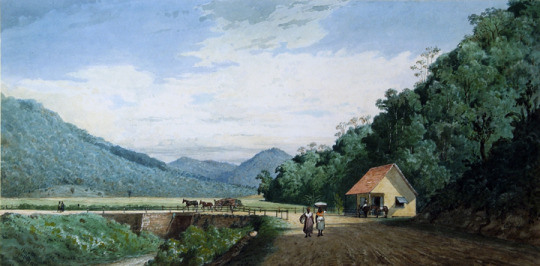
Cazabon started painting under Paul Delaroche, a leading painter of that time in Paris. He soon became popular as a society painter of Trinidad scenery; and of portraits of planters and merchants of Port of Spain. It is due to his paintings that we have a fair view of Trinidad’s way of life in the 19th century.
His works include images of the Caroni river, the Port of Spain docks, sea views and other landscapes. He preferred using watercolors combining stunning pallets that remain fresh and bright to this day. Some of this most important works are part of the following collections:
‘Views of Trinidad’ (18 lithographs, 1851)
‘The Harris Collection’ (44 paintings, 1848-1854)
‘Album of Trinidad’ (18 lithographs, 1857)
In England and France his work was much admired and he won several awards and medals at exhibitions. His first exhibition was at the Salon du Louvre in 1839, followed by expositions every year from 1843 to 1847. Back at home his art was much less appreciated. Disillusioned with life he became a drunken eccentric.
After his death in 1888, Cazabon’s style gained more recognition in the region and his influence grew. Today he is considered to be one of the first great painters of the Caribbean. His work is appreciated for the rich details and for the use of light and shadow.
His scenes of a clean, natural and unspoiled Trinidad show a country as it was before the heavy industrialization of the twentieth century.To many Trinidadians the scenes are familiar, creating a tremendous sense of nostalgia.




 Caribbean Painters